 Cáo Studio
Home › Blog › Pre-Wedding & Elopement
What to Wear for Couple Photos at Mui Ne White Sand Dunes
By the Cáo Studio team · Hanoi & Saigon · 2026-11-02
Mui Ne's white sand dunes demand outfits that breathe, don't cling, and hold colour under midday sun. We at Cáo Studio choose fabrics like linen, cotton linen blends, and lightweight silk for couples' sessions there—loose cuts that move in wind, neutrals and jewel tones that pop against white, and layers you can shed fast. Avoid heavy synthetics (they stick to skin in 35°C heat), busy patterns (sand and detail fight for attention), and anything precious you can't wash sand from. Most couples spend two to three hours on the dunes; half in soft morning light, half scouting new angles. Budget one outfit change, plan shoes you can lose, and bring a water bottle and hat for crew.
We've shot couples at Mui Ne's white sand dunes since 2022. Every session teaches us something new about what works—and what you pack becomes part of the shoot story itself. Here's how our team thinks about it.
Why does white sand make outfit colour so hard to predict?
White sand is a light source, not just a backdrop. It bounces sun up at your face and body, washing out cool tones and muting darks unless you nail the angle and time. We've seen couples arrive in pastels that looked lovely in their hotel mirror and turn nearly invisible in the dunes by 10 a.m. The sand shifts every few metres—some patches are whiter, some carry more shadow from scrub. On the last shoot there, our stylist brought three test fabrics to the dunes at dawn and shot them side by side; mustard linen held colour best, nude blended completely, and sage green split the difference. Jewel tones—emerald, sapphire, rust—stay distinct. Whites work only if you layer texture (knit, embroidery, fringe) so the outfit reads as outfit, not as extension of the dunes.
Chat with us on WhatsApp | See packages and prices on vietnamphotoshoot.com
What fabric choices keep you moving without clinging in Mui Ne heat?
At 35°C on white sand, heavy cotton absorbs sweat and sticks to ribs and thighs within an hour. We pair couples in linen (breathes, wrinkles photogenically, dries fast if you wade into the nearby lagoon), cotton-linen blends (60/40 or 55/45; stronger than pure linen, still cool), and high-quality rayon (drapes loose, doesn't grip). Silk is risky—it clings when wet and stains if sand gets inside layers. Synthetic fabrics trap heat and create shine that reads flat in bright sun. On last month's shoot, the groom wore pure linen shirt (three sizes loose) and moved freely even during jumping shots; the bride wore a cotton-linen dress and we had to do only one break for water in four hours. Denim and structured cotton poplin feel safe but will defeat you by hour two. Bring an undershirt or slip beneath sheer pieces so you don't flash when wind lifts fabric.
How do you work around wind without losing the shot?
Mui Ne's afternoon wind (3–5 p.m.) can blow a veil sideways or paste fabric to your legs in ways that don't read well on camera. We scout the dunes at location-scout visits to find wind shadows—small valleys or slopes where air flow slows—and plan sequences there. For open dunes, we ask couples to position side-on to the wind (so it catches fabric from the side, not head-on) or we shoot into the wind so hair and fabric travel away from you both and frame the shot. Our photographer keeps backup positions on low ground where wind drops. If skirts are full, we sometimes ask you to hold the hem—it sounds awkward, but it reads as intentional and playful. Loose clothing moves beautifully in wind; tight cuts fight it and look pinched. We've learned to embrace the wind rather than fight it; most of our favourite Mui Ne shots have fabric mid-motion.
Should couple outfits match, coordinate, or contrast?
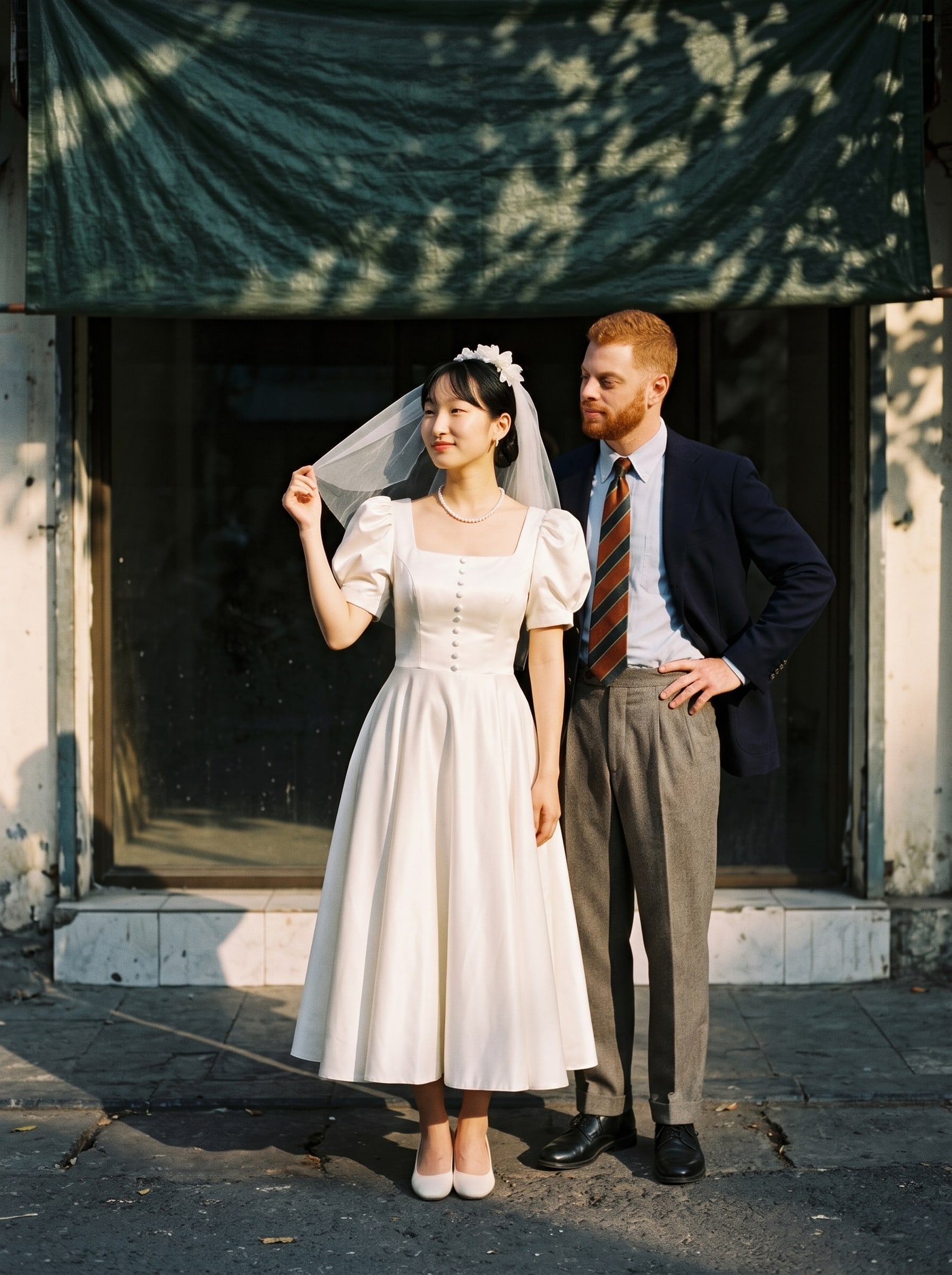
There's no rule, but we see patterns. Coordinated neutrals (beige linen for her, soft taupe for him) photograph like one unit—dreamy, cohesive, works in any light. Tonal contrast (his dark blue linen shirt, her rust dress, both natural fibres, both mid-tone) creates separation without clashing. Full opposite-colour looks (red and navy, emerald and gold) can feel costume-y on white sand unless the fabrics and fit are so good they carry it. We've shot all three and they work equally—the driver is confidence and the people inside the clothes. On our last session there, the couple wore matching cream linen and added jewellery to define who was who; the photos read as intimate and unhurried. The couple before them wore his navy shirt and her burnt-orange dress; they looked editorial and strong. Ask yourself: do we want to feel like one unit, or do we want to stand as individuals who chose each other?
What shoes and accessories actually survive Mui Ne sand?
Hard-soled shoes sink and slip on fine white sand. Bare feet work if you're comfortable (the sand cools in early morning, burns by 10 a.m.); flat sandals or leather slip-ons are fastest to lose and find; canvas sneakers hold if you accept they'll need heavy cleaning. We've seen couples lose a shoe mid-embrace and have to laugh it off—it happens so often we now brief you on the walk out about where to plant feet for stability. Accessories: long pendant necklaces swing during movement and catch sand; chunky earrings photograph well; bracelets and watches leave tan lines if you remove them later. Hats (wide-brim straw, cotton bucket, structured linen) protect skin and frame faces in wide shots. We often ask one partner to hold the hat in the shot rather than both wearing one—it adds a narrative beat.
| Choice | Who It's For | Why It Works | What to Watch |
|---|---|---|---|
| Linen separates (loose shirt + trousers/skirt) | Couples who want movement and texture | Breathes, wrinkles beautifully, weight is obvious | Needs pressing before shoot; can over-wrinkle |
| Cotton-linen blend dress (breezy, knee-length or longer) | Partners wanting simplicity and comfort | One piece, cool, drapes, hides sand easily | Blends can cost more; check weight before ordering |
| Silk or silk-like rayon evening wear | Couples aiming for formal/editorial feel | Elegant drape, stands out against white | Stains easily; wrinkles persist; heavy cleaning after |
| Matching neutral outfits (both in cream or taupe) | Couples wanting unified, romantic look | Reads as "at peace together"; forgiving light | Can feel generic without texture or layers |
| Contrast linen (her jewel tone, his neutral) | Partners who like definition and editorial feel | Clear separation; colour pops; balanced energy | Requires confident styling; must fit well |
What to check before you book and pack
Before you order anything new for the shoot, ask yourself: Can I move freely in this for two hours without adjusting? Sit down, reach forward, stretch your arms—if anything pulls, binds, or gaps, it will bug you in photos. Does the fabric breathe and dry fast? Linen and cotton-linen are safest; try on anything synthetic in a warm room for five minutes. Is the colour visible in bright light without looking washed? Jewel tones and saturated neutrals win; pastels and pure white need texture to read. Can I walk through soft sand in these shoes without sinking or twisting? Practice on a beach before the shoot. Do I want my partner to see me in this before the dunes? If the outfit feels like "costume," it will read that way on camera.
We recommend starting your outfit search with linen and cotton-linen pieces from casual wear brands—not "wedding" lines, which often overstyle for air-conditioned ballrooms, not 35°C dunes. Shop three to four weeks ahead so pieces arrive, you wear them a few times (linen softens with washing), and you know the fit. Bring two outfits if your couple photoshoot package allows outfit changes; one for soft morning light, one for golden hour.
Chat with us on WhatsApp | See packages and prices on vietnamphotoshoot.com
Most couples we've worked with at Mui Ne spend three to four hours at the location—enough time to chase light, explore different zones, and settle into the lens. Wind, heat, and sand are features, not obstacles. The couples who moved most fluidly wore pieces they'd already worn three or four times before; the fabric felt like skin, and they forgot the outfit entirely and focused on each other. That's when the light hits just right and the sand becomes your stage.
Our pre-wedding photoshoot team can also book you makeup and hair sessions at your Mui Ne hotel the morning of the shoot—makeup that holds in heat and humidity makes a real difference. If you're planning a larger group moment, ask about our family photoshoot package options, which include outfit guidance for mixed ages and formality levels.
See packages and prices on vietnamphotoshoot.com
FAQ
Can we wear jeans or structured cotton to Mui Ne dunes?
Jeans will feel heavy and restrictive in 35°C heat within an hour and photograph stiffly. Structured cotton (like poplin or canvas) works for shorter sessions (under 90 minutes) but tends to show sweat and won't move as beautifully in wind as linen or blends do.
Should my partner and I dress formal or casual?
Casual linen and cotton-blend separates photograph more authentically on Mui Ne than formal wear; the dunes suit movement and texture over structure. If you want formal energy, choose tailored linen (breathable but sharp-lined) rather than silk or heavy cotton.
What happens if we get sand inside our clothes?
It's nearly unavoidable and we factor it in. Choose fabrics you can rinse and air-dry fast—linen dries in 15 minutes in sun and breeze. Avoid pockets on the outside where sand collects, and wear a slip or undershirt under sheer pieces to reduce irritation.
Is it worth buying new outfits or can we wear what we already own?
Wear existing linen, cotton-linen, or breathable pieces you've tested before. Shopping new adds stress and fit risk. New pieces need washing and wearing-in; you'll feel more confident in clothes you know.
What if we shoot at a different time of day—does outfit advice change?
Early morning (6–8 a.m.) allows pastels and lighter tones; midday (10 a.m.–2 p.m.) demands jewel tones and darker neutrals to read against bright sand. Golden hour (4–6 p.m.) is forgiving for most colours but brings stronger wind. Your photographer will brief you on timing during planning.
Can we wear traditional Vietnamese áo dài at Mui Ne dunes?
Silk áo dài is stunning but clings to skin in heat and stains easily. We've shot couples in linen áo dài (custom or adapted) which breathes better; pair it with loose cotton trousers. Discuss áo dài interest in planning so we can guide fabric and styling.
Pre-Wedding & Elopement
Inclusions, prices and booking are on our booking site.
FAQ
Can we wear jeans or structured cotton to Mui Ne dunes?
Jeans will feel heavy and restrictive in 35°C heat within an hour and photograph stiffly. Structured cotton (like poplin or canvas) works for shorter sessions (under 90 minutes) but tends to show sweat and won't move as beautifully in wind as linen or blends do.
Should my partner and I dress formal or casual?
Casual linen and cotton-blend separates photograph more authentically on Mui Ne than formal wear; the dunes suit movement and texture over structure. If you want formal energy, choose tailored linen (breathable but sharp-lined) rather than silk or heavy cotton.
What happens if we get sand inside our clothes?
It's nearly unavoidable and we factor it in. Choose fabrics you can rinse and air-dry fast—linen dries in 15 minutes in sun and breeze. Avoid pockets on the outside where sand collects, and wear a slip or undershirt under sheer pieces to reduce irritation.
Is it worth buying new outfits or can we wear what we already own?
Wear existing linen, cotton-linen, or breathable pieces you've tested before. Shopping new adds stress and fit risk. New pieces need washing and wearing-in; you'll feel more confident in clothes you know.
What if we shoot at a different time of day—does outfit advice change?
Early morning (6–8 a.m.) allows pastels and lighter tones; midday (10 a.m.–2 p.m.) demands jewel tones and darker neutrals to read against bright sand. Golden hour (4–6 p.m.) is forgiving for most colours but brings stronger wind. Your photographer will brief you on timing during planning.
Can we wear traditional Vietnamese áo dài at Mui Ne dunes?
Silk áo dài is stunning but clings to skin in heat and stains easily. We've shot couples in linen áo dài (custom or adapted) which breathes better; pair it with loose cotton trousers. Discuss áo dài interest in planning so we can guide fabric and styling.
More from the team
Boho pre-wedding photoshoot in Vietnam: Hanoi, Saigon, Hoi An
Boho pre-wedding shoots mix romantic, free-spirited aesthetics with Vietnam's landscapes and heritage sites. We run full-day sessions in three cities, handling styling, makeup, location scouts and edits.
Avoid crowds at Hoang Su Phi rice terraces: timing for wedding shoots
Hoang Su Phi's terraced landscape draws couples and tour buses in equal measure. We show how to shoot there alone, when to arrive, and what to arrange with us before you go.
Photography rules at Con Dao beaches: permits, drones and what to check
Con Dao's beaches demand prep before you shoot—permits, drone zones and tide timing all affect your day. We share what the Cáo Studio team verifies on every booking.