 Cáo Studio
Home › Blog › Pre-Wedding & Elopement
What to Wear for Couple Photos at O Quy Ho Pass
By the Cáo Studio team · Hanoi & Saigon · 2026-11-02
O Quy Ho Pass demands clothes that look romantic and survive the cold. We've shot couple sessions there since 2019 and learned the hard way: lightweight layers beat bulky coats, wind-resistant fabrics outperform loose cotton, and colour choice matters more than you think when fog rolls in. Aim for long-sleeve tops (thermal or merino underneath), tailored trousers or fitted skirts, a windproof outer layer you can remove for photos, and closed shoes with grip. Avoid white and pale pastels—they vanish in cloud cover. At 3,143 metres, temperature swings 15°C from midday to late afternoon, so pack a second layer even if it feels warm at 8 a.m. Cáo Studio guides all couples through this on WhatsApp before the shoot, and we often style borrowed jackets or wraps that photograph well. Budget 2–3 hours for the shoot itself; 90 minutes is minimum if wind picks up. Chat with us on WhatsApp | See packages and prices on vietnamphotoshoot.com
O Quy Ho Pass sits 3,143 metres above sea level on the border between Lao Cai and Lai Chau provinces. The temperature drops sharply, wind cuts through thin fabrics, and fog rolls in unpredictably—so what you wear makes or breaks your couple photos. We've shot couple sessions there since 2019 and learned the hard way: lightweight layers beat bulky coats, wind-resistant fabrics outperform loose cotton, and colour choice matters more than you think when fog rolls in. Aim for long-sleeve tops (thermal or merino underneath), tailored trousers or fitted skirts, a windproof outer layer you can remove for photos, and closed shoes with grip. Avoid white and pale pastels—they vanish in cloud cover. At 3,143 metres, temperature swings 15°C from midday to late afternoon, so pack a second layer even if it feels warm at 8 a.m. Cáo Studio guides all couples through this on WhatsApp before the shoot, and we often style borrowed jackets or wraps that photograph well. Budget 2–3 hours for the shoot itself; 90 minutes is minimum if wind picks up.
Why layering beats a single heavy coat at altitude
A thick down parka photographs stiff and overwhelms the frame. We ask couples to wear fitted base layers (merino wool or synthetic, not cotton—it holds sweat and chills you fast) under a long-sleeve shirt, then a lightweight windproof shell they can slip off for hero shots. This way you stay warm during setup and transit, look sleek in photos, and avoid the puffy silhouette that kills couple composition. We've noticed couples who wear one heavy layer regret it by hour two: they're either overdressed for the sun or underdressed when wind spikes. The sweet spot is three thin layers you can mix-and-match on the fly. Your base layer stays on; the shell comes off for close-ups; the mid-layer (fleece or wool) adjusts based on wind gusts we spot minute-by-minute on location.
What colours actually show up in O Quy Ho's fog
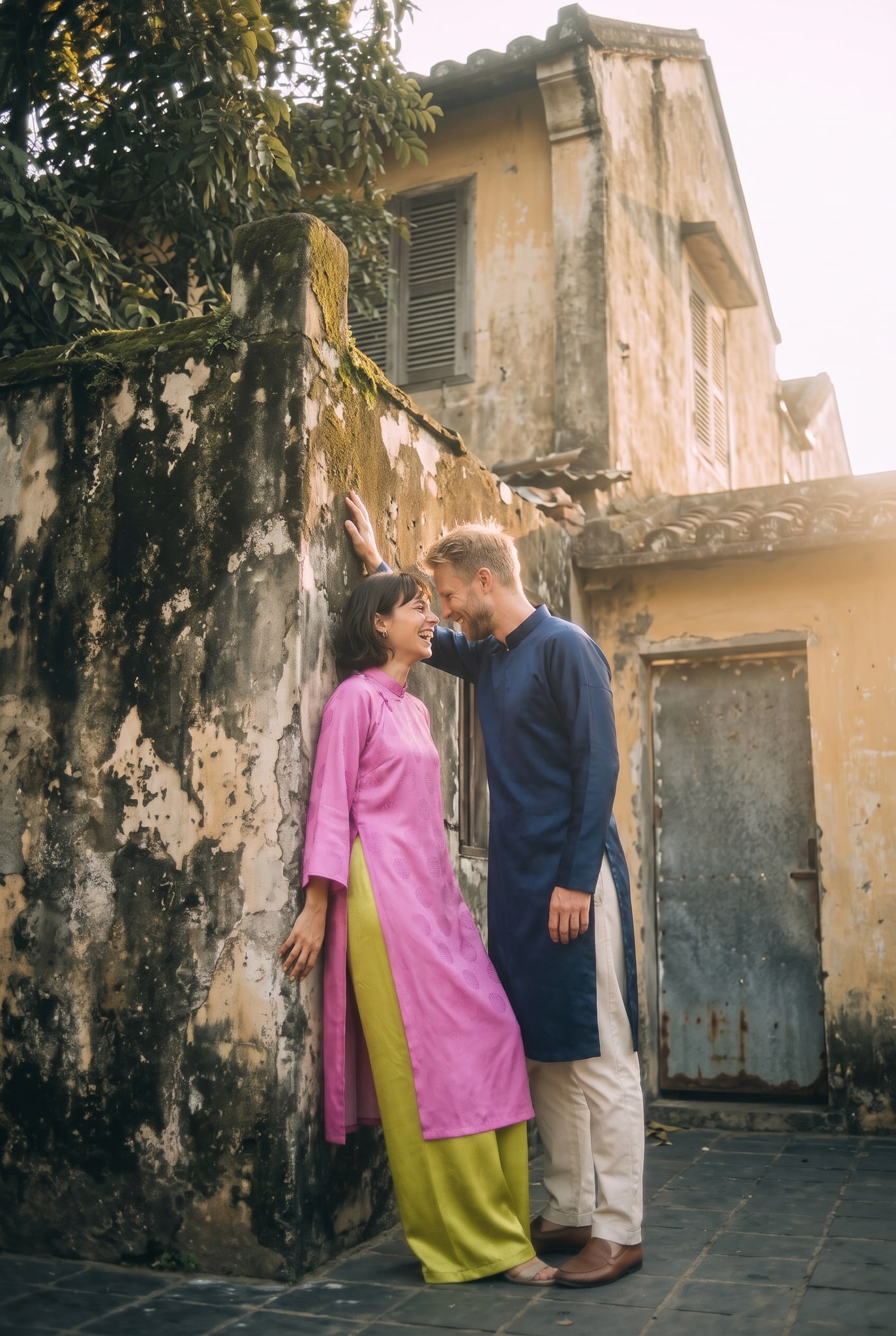
Fog at 3,143 metres isn't romantic mist—it's opaque cloud that swallows pale colours entirely. We learned this during our first season: a couple in ivory and pale grey blended into the white-out; we shot for an hour and barely salvaged 40 usable frames. Now we guide clients toward jewel tones (deep emerald, sapphire, burgundy), warm neutrals (camel, rust, charcoal), or earth tones (terracotta, olive). Black works if the background stays visible; navy is safer. We also avoid all-white outfits unless the weather forecast promises clear skies—and even then, wind-blown hair reads better against a dark base. Patterns (checks, stripes, subtle prints) photograph sharper than solids in low visibility. If a couple insists on light colours, we schedule them for early morning (6:30–7:30 a.m.) when visibility is usually best, or we compose tighter shots that rely less on background depth.
See couple photoshoot packages
Footwear that won't slip on wet stone
O Quy Ho's concrete and stone walkways become slick after rain or morning dew—common at that altitude. We've seen couples in flat dress shoes or heels lose footing during pivotal shots. Closed-toe hiking shoes, trail runners, or boots with aggressive treads are non-negotiable. Save dressy footwear for the car; change into grip-soled shoes on location. Many couples ask if they can go barefoot for a few frames; the answer is yes, only on dry grass and only for 30 seconds—the stone is too cold and the risk of cuts is high. We always carry microfibre cloths and occasionally ask couples to wipe soles before each setup. One couple wore beautiful leather loafers they insisted would "be fine"—we spent 20 minutes on safety checks instead of shooting. Bring a second pair of socks in case the morning dew soaks your first pair.
How wind direction shapes outfit choices on the day
Wind at 3,143 metres comes from the northwest (November to March) or southwest (May to September). We check real-time wind speed on the morning of the shoot and text couples a heads-up: if gusts exceed 35 km/h, flowing skirts and loose fabrics become liabilities—they flap uncontrollably and obscure your face. Fitted trousers or knee-length structured skirts stay in frame. We also position you with wind at your back so hair blows away from your face, not into it. One couple wore a voluminous tulle skirt in March; the wind was 40 km/h that day and we spent half the shoot holding the fabric down. Now we ask about outfit plans 3–4 days ahead, check the forecast, and suggest adjustments if needed. A simple rule: if wind is forecast above 30 km/h, choose fitted silhouettes and secure loose elements (scarves, hats, hair clips that won't hold).
Bringing a backup outfit: when and why we recommend it
Not every couple needs two outfits at O Quy Ho—it's a single-location shoot with 2–3 hour windows. But if your couple photoshoot package includes multiple locations or you're doing a pre-wedding session that spans half a day, a second outfit (same layering logic, different colour) doubles your editing options and handles wardrobe mishaps. One bride's boyfriend's jacket got caught in a gate hinge and tore; they had a backup shirt underneath. Another couple's base layer developed a stain during the drive; the spare top saved the afternoon. We don't require backups, but we mention them on WhatsApp if we sense extended plans. A backup outfit also lets us shoot "then" and "now" vibes—casual for the first look, refined for sunset frames. If you do bring a second outfit, pack it in a garment bag in the car and change on-site; wrinkled fabrics from being stuffed in a backpack photograph badly and take time to steam.
Comparison table: outfit types by weather and vibe
| Outfit type | Best for | Key pieces | Wind risk | Fog visibility |
|---|---|---|---|---|
| Fitted knitwear + tailored trousers | Cool, polished, everyday romance | Merino sweater, chinos, windproof shell | Low | High (dark base layer shows) |
| Structured dress + cardigan + tights | Elegance with mobility | Midi dress, fitted cardi, thermal tights | Medium (if skirt is A-line) | Medium (depends on dress colour) |
| Casual layers (tee + fleece + overshirt) | Relaxed, playful, editorial | Long-sleeve base, fleece mid-layer, linen overshirt | Low | High (neutral tones pop) |
| Skirt + fitted top + jacket | Feminine, romantic, dress-up vibe | Knee-length skirt, tucked top, shell jacket | High (avoid flowing fabrics) | Medium-high (tucked silhouette reads clearly) |
What to check before you buy or borrow clothes
- Colour holds up in grey light: Take a test photo outdoors on an overcast day. Does the outfit vanish or pop?
- Fabric moves with you: Sit, crouch, lean. Can you pivot your torso? Are you restricted?
- Seams don't pinch under layers: Try your base layer + mid-layer + shell together. No bunching at shoulders or armpits?
- Shoes grip wet surfaces: Press the sole firmly on a wet tile or step. Does it feel stable or slippery?
- Wind resistance is real: Stand outside on a breezy day. Does the outfit flap, or does it stay put?
- You feel genuinely warm at 10°C: Dress in your full outfit and sit outside for 15 minutes at dawn. Warm enough? If not, add another layer.
Real adjustments we make on the day
We arrive at O Quy Ho by 6:45 a.m. to scout light and check conditions. If fog is thicker than forecast, we shoot tighter portraits and skip wide landscape frames. If wind spikes unexpectedly, we shift to sheltered spots near the stone markers. We often ask couples to tie back hair if the wind is strong—a simple high ponytail photographs better than loose strands across the face. If someone is visibly cold (shivering, hugging themselves), we build in 5-minute warm-up breaks in the vehicle between setups. And if an outfit fails—seams separate, a shoe sole peels—we problem-solve fast: tucking, safety pins, sometimes a simple pose change that hides the flaw. One couple's boyfriend's shirt came unbuttoned during a walking shot; we laughed, rebuttoned, reshot, and the outtake became their favourite frame because it felt honest.
See pre-wedding and elopement packages
Ready to book a couple shoot at O Quy Ho or another high-altitude or dramatic location? Our team in Hanoi (nearest to the pass) handles all logistics—we'll walk you through outfit choices on WhatsApp, suggest timing based on weather forecasts, and ensure your clothes work for the conditions you'll face. We also offer hotel makeup and hair services if you want professional styling before the drive north.
Chat with us on WhatsApp | See packages and prices on vietnamphotoshoot.com
FAQ
Should I buy new clothes for O Quy Ho or borrow from friends?
Borrow if fit and colour match your vibe and the weather forecast. Buying new means you own pieces for future shoots—but trying on in advance is critical. Neither is wrong; we've styled both beautifully. The key is testing everything on-site at least once before the shoot day.
What if I wear a wedding dress at O Quy Ho?
Possible, but challenging. Wedding dresses are often heavy, voluminous, and pale—all risky at 3,143 metres with unpredictable wind and fog. If you're planning an elopement or pre-wedding shoot there, we suggest a second ceremony dress in a structured jewel tone, or a fitted reception gown instead of a ball gown. Ask us on WhatsApp to discuss your specific vision.
Can we change outfits during the shoot?
Yes, if your package includes it and we have time. We usually budget 30 minutes per outfit change (travel to the vehicle, change, return). For a 2-hour shoot, one outfit is standard; a 4-hour session can accommodate two.
Do you provide jackets or wraps we can borrow for photos?
We sometimes have windproof shells or wool wraps available for styling—ask when you book. We don't guarantee stock, so bringing your own is safest. If you have pieces you love but aren't sure about, send us photos on WhatsApp and we'll advise.
What happens if the weather turns bad on shoot day?
We monitor forecasts 5 days out and alert you to risks. If conditions deteriorate the morning of, we can postpone, move to a lower-altitude backup location (like Sapa town or the Old Quarter in Hanoi), or reschedule. Full details are in your package terms—ask us on WhatsApp for specifics.
Is there a "best" time of year to shoot at O Quy Ho?
September to October and March to April offer the clearest visibility and most stable weather. November to February is colder but often misty. May to August is rainy. We factor season into outfit advice—heavier layers for winter, lighter merino for spring. Tell us your dates and we'll guide the wardrobe strategy.
Pre-Wedding & Elopement
Inclusions, prices and booking are on our booking site.
FAQ
Should I buy new clothes for O Quy Ho or borrow from friends?
Borrow if fit and colour match your vibe and the weather forecast. Buying new means you own pieces for future shoots—but trying on in advance is critical. Neither is wrong; we've styled both beautifully. The key is testing everything on-site at least once before the shoot day.
What if I wear a wedding dress at O Quy Ho?
Possible, but challenging. Wedding dresses are often heavy, voluminous, and pale—all risky at 3,143 metres with unpredictable wind and fog. If you're planning an elopement or pre-wedding shoot there, we suggest a second ceremony dress in a structured jewel tone, or a fitted reception gown instead of a ball gown. Ask us on WhatsApp to discuss your specific vision.
Can we change outfits during the shoot?
Yes, if your package includes it and we have time. We usually budget 30 minutes per outfit change (travel to the vehicle, change, return). For a 2-hour shoot, one outfit is standard; a 4-hour session can accommodate two.
Do you provide jackets or wraps we can borrow for photos?
We sometimes have windproof shells or wool wraps available for styling—ask when you book. We don't guarantee stock, so bringing your own is safest. If you have pieces you love but aren't sure about, send us photos on WhatsApp and we'll advise.
What happens if the weather turns bad on shoot day?
We monitor forecasts 5 days out and alert you to risks. If conditions deteriorate the morning of, we can postpone, move to a lower-altitude backup location (like Sapa town or the Old Quarter in Hanoi), or reschedule. Full details are in your package terms—ask us on WhatsApp for specifics.
Is there a "best" time of year to shoot at O Quy Ho?
September to October and March to April offer the clearest visibility and most stable weather. November to February is colder but often misty. May to August is rainy. We factor season into outfit advice—heavier layers for winter, lighter merino for spring. Tell us your dates and we'll guide the wardrobe strategy.
More from the team
Boho pre-wedding photoshoot in Vietnam: Hanoi, Saigon, Hoi An
Boho pre-wedding shoots mix romantic, free-spirited aesthetics with Vietnam's landscapes and heritage sites. We run full-day sessions in three cities, handling styling, makeup, location scouts and edits.
Avoid crowds at Hoang Su Phi rice terraces: timing for wedding shoots
Hoang Su Phi's terraced landscape draws couples and tour buses in equal measure. We show how to shoot there alone, when to arrive, and what to arrange with us before you go.
Photography rules at Con Dao beaches: permits, drones and what to check
Con Dao's beaches demand prep before you shoot—permits, drone zones and tide timing all affect your day. We share what the Cáo Studio team verifies on every booking.